
MLA vs. APA vs. Your Authentic Voice
A blog writing vs essay writing story: what happens when a grammar checker built for essays meets a blog post, and why I wasn’t surprised who won
“I knew it! The old essay style writing is baked into Yoast, and the modern style of blog writing can be more casual, and conversational style.”
That’s what came out of my mouth the moment I saw two little orange dots on my screen. Not red, orange. The color WordPress uses for “technically a problem, but let’s not panic.” What followed was an accidental, very real-time argument about blog writing vs essay writing, one I didn’t expect to have with a piece of software before my coffee finished.
Twelve Years of MLA, Four Years of APA, and Zero Years of Anyone Asking If It Actually Works
Let’s rewind for a second, because I think most of you reading this had the same education I did. High school: five-paragraph essays, topic sentences, no contractions, never start a sentence with “And.” College: MLA if you were in the humanities, APA if you strayed anywhere near the social sciences, and a professor somewhere circling every semicolon you misused in red ink. University: more of the same, just with footnotes now.
Nobody ever asked whether those rules made writing better. They just were the rules. You followed them, you got the grade, you moved on. Vary your sentence openers. Use transition words. Never repeat a sentence structure twice in a row. It was drilled in so deep that most of us can still recite it decades later, the way you can still recite the alphabet song without thinking about the letters.
Here’s the punchline: it turns out software remembers those rules too. Better than I do, apparently, because it’s still checking for them.
Setting Up Yoast for the First Time
I was cleaning up the SEO on a post about Google Analytics, a topic I’d written the way I actually talk to my students: first person, a bit of a story about a hosting dashboard that lied to me, some steps to follow, nothing fancy. I’d never used Yoast before this project. I turned it on, ran the analysis, and started fixing what it told me to fix.
Some of it was genuinely useful. My subheadings weren’t real subheadings. They were just bold-looking lines of text sitting in a Custom HTML block, invisible to anything actually reading the page’s structure. Once those got wrapped in real heading tags, that flag went green immediately. Fair enough. That’s not a style opinion, that’s just how a page is built.
Then I hit two orange dots that felt different.
The Two Flags I Wasn’t Buying
Sentence length: Yoast wanted more of my sentences under 20 words. I had a chunk running about a quarter of them longer than that.
Transition words: Yoast wanted roughly a third of my sentences to contain a word from its approved list: “however,” “therefore,” “furthermore,” that whole formal toolbox, and I was sitting under 30%.
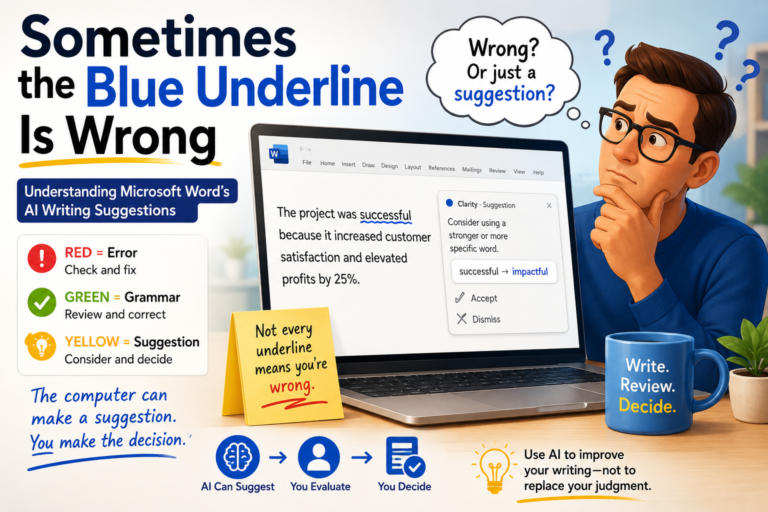
My first reaction wasn’t “let me fix this.” It was “wait a minute.” This isn’t a term paper. Nobody assigned me this. Nobody’s grading it for structure. It’s a blog post written to sound like a person talking, not an essay written to survive a rubric. And the moment I said that out loud, I realized I already knew exactly why those two flags didn’t apply, because I’ve been teaching the difference for years.
The Question I Wasn’t Expecting
I asked my AI assistant something I was genuinely curious about: how did I catch that in a matter of seconds, having never opened Yoast before in my life?
The answer stuck with me. I wasn’t evaluating Yoast’s rules in isolation. I was checking them against something I already trusted: thirty-plus years of watching what actually lands with a room full of students versus what just satisfies a rubric. That’s a different skill than knowing a piece of software. Yoast was scoring syntax. I was scoring “does this sound like a person talking to my class,” and I already had a strong opinion on the answer before Yoast ever weighed in.
What made it interesting, though, wasn’t that I rejected the tool outright. Not even close. Without really meaning to, I sorted its feedback into two piles: structure, things like subheadings and paragraph length, which matter no matter what style you’re writing in, and register, things like sentence length and transition-word density, which only matter if you’ve decided your writing should sound formal in the first place. The first pile, I kept. The second, I waved off. That’s not beginner’s luck. That’s just judgment I already had, applied to a tool I’d never touched.
The Blog Writing vs Essay Writing Debate I Have With My Students
This is the exact thing I explain in class when we get to the blog writing assignment. In the ongoing debate of blog writing vs essay writing, blog style has a real advantage over essay style, and it’s not just that it’s easier or lazier. It’s a different tool for a different job.
It’s more relatable and natural. Contractions, direct address, the occasional sentence fragment, a first-person voice: all of it mimics how people actually talk. That closes the distance between writer and reader. Essay style, with its formal third person and its careful transitions, creates distance on purpose. That’s appropriate for its job. It’s the wrong job for a blog trying to earn someone’s trust.
It’s easier to read, and that’s measurable, not just a feeling. Nobody reads a blog post start to finish the way they’d read an assigned essay. They scan. Shorter paragraphs, varied sentence length, real subheadings: all of it reduces the effort of scanning. Essay-style writing is built for a reader who has already committed to reading the whole thing. A blog reader hasn’t committed to anything. They can leave mid-sentence, and they often do.
It’s more useful, because of the authentic voice underneath it. This is the part most writing instruction skips entirely. A reader trusts a consistent, slightly imperfect human voice more than they trust polished, generic prose, especially when they’re reading for advice. My Google Analytics post works because it reads like me talking to my class, mistakes and lessons included, not like a textbook chapter. Anyone can explain what GA4 tracks. Not many people can tell you the story of catching their own hosting dashboard lying to them, and have you believe it, because it actually happened.
What Twelve Years of Rules Were Missing
Here’s where I’ve landed on it, after all this blog writing vs essay writing back-and-forth. All those years of MLA, APA, and essay structure weren’t wrong, they taught discipline, and discipline is worth having. But somewhere along the way, the rules themselves got put on the podium instead of what the rules were supposed to serve. Clarity. Connection. Getting an idea out of one head and into another intact.
After decades of that, rules first, meaning second, it turns out the thing actually worth chasing was the other way around the whole time. Authenticity married to a flexible structure carries something rigid formality never could: emotional connection. Essence. The sense that an actual person wrote this, for you, and meant it.
Yoast isn’t wrong about everything. Structure still matters. A page still needs to be readable, navigable, built the way pages are built. But the moment a checklist starts asking you to sound less like yourself, that’s the moment to trust the thirty years of experience over the software. I did, in about five seconds, without even meaning to.
MLA Style
Developed by the Modern Language Association, MLA is the standard for English, literature, and language courses. It favors author-page in-text citations and a Works Cited list, built for close analysis of texts.
Visit the MLA Style Center →APA Style
The American Psychological Association’s format is the standard across psychology, education, and the social sciences. It emphasizes author-date citations and a clear, bias-free, scholarly tone.
Visit the APA Style site →Essay Writing Rules
Thesis statements, topic sentences, five-paragraph structure, formal transitions — the rules most of us were graded on for over a decade. Built for a reader who has already committed to reading the whole thing.
See Purdue OWL’s essay guide →Blog Style Writing
Contractions, short paragraphs, direct address, a voice that sounds like a person talking — written to earn a reader’s attention one sentence at a time, not to satisfy a rubric.
Read HubSpot’s conversational writing tips →




A like fades in a second. A comment lives on and helps this moment spread across the globe.
Tell us what it meant to you ↓