Sometimes the Helpful Cousin Is the Problem
A conversation about Microsoft Word, ChatGPT, students, and the house style nobody admitted they were joining. The Story That Still Opens the Door. I did not start this by asking an AI for a hot take. I started with a classroom memory. About twenty years ago, a teacher prepared a presentation on public speaking. The title said Pubic Speaking. The old spellchecker did not underline it. Pubic is a word. The computer was technically correct and socially unhelpful, which is a very computer way to be. That story still works. It is funny. It is clean. It makes people lean in. The harder story is the one that comes after it. The Old Problem and the New One What the old spellchecker could not do. The old tool checked whether a word existed. It did not ask:
- Who is the audience?
- What did the writer mean?
- What will a human being see first?
- What disaster is hiding inside a correctly spelled word?
A human reader understood the intended meaning immediately. The software did not. It was checking words, not understanding language.What modern Word does insteadToday’s Microsoft Word can consider context, sentence structure, clarity, conciseness, formality, word choice, and a long list of social and cultural categories. That is a genuine improvement. It is also a different kind of authority.The danger is no longer only that the software misses a joke.The danger is that users give every recommendation the authority of a correction.Three Different Kinds of Writing FeedbackI examined Word’s Grammar and writing options and counted them. The result was surprising: 136 distinct options across 12 screenshots, with 139 visible option lines because three items appeared again during scrolling.Those options are not all doing the same job.1. Traditional language mechanicsThese generally ask: is there something wrong with the construction of this sentence?
- Spelling
- Punctuation
- Subject-verb agreement
- Verb tense
- Sentence fragments
- Missing words
- Word order
- Grammar
- Syntax
- Basic sentence structure
2. Writing quality and styleThese are not always questions of right and wrong. They ask whether something could be expressed differently.
- Clarity
- Conciseness
- Wordiness
- Clichés
- Weak verbs
- Unnecessary words
- Unnecessary adverbs
- Vocabulary
- Formality
- Jargon
- Informal language
- Passive voice
- Repetition
- Conventional phrasing
3. Social and cultural interpretationThese involve culture, audience, history, context, and changing conventions.
- Age bias
- Cultural bias
- Disability bias
- Ethnic slurs
- Gender bias
- Gendered pronouns
- Gender-specific language
- Mental-health bias
- Racial bias
- Sexual-orientation bias
- Socioeconomic bias
- Sensitive geopolitical references
- Profanity
- Slang
- Region-specific language
A spelling error is one kind of event. “Consider using another word” is another. When a Suggestion Becomes an Invisible Ideological Edit. The most important risk is not that Microsoft Word forces a political position. In ordinary use, it usually does not. Many of the most contested checks are optional. The quieter risk is this: a document can change its moral temperature, implied audience, theory of the person, and even its account of the world, one accepted underline at a time, while the writer still believes they are only “fixing writing. ”That is an invisible ideological change. Nothing in the interface says, “You are now adopting a different theory of gender, history, class, nation, or human agency. ”The interface says something much more familiar: consider another word. Ideology does not live only in the “bias” boxes. The Inclusiveness group is the obvious place to look. But if we stop there, we miss the larger problem. Any option that systematically prefers one kind of sentence can also prefer one kind of world. How ordinary “quality” options can move a text Conciseness and wordiness.
A shorter sentence often looks like an improvement. It can also erase testimony. Efficiency can become euphemism. Clarity and conventional phrasing “Clear” often means “the version most readers in a corporate or academic setting already expect.” Conventional phrasing is not just style. It is consensus wearing a grammar coat. Formality, slang, and informal language
Turning formality up can push a writer out of the speech of their community and into institutional English. Over time, the software teaches a hierarchy: the official register is “better writing.”Jargon and vocabulary
Whose jargon is jargon? A checker that flags specialist words may help a general audience—or tell one community that its way of naming reality is less legitimate.Weak verbs and “stronger” word choice
Verbs carry moral weight. Died, was killed, passed away, lost their life, and was murdered are not interchangeable. A vocabulary suggestion can rewrite blame, consent, accident, and intention. Passive voice. Flagging the passive can be good craft advice. It can also pressure a writer toward a preferred assignment of agency. Repetition, Political speech, liturgy, protest, and teaching often repeat on purpose. A refinement that treats repetition as a flaw prefers a memo to an oration. Region-specific language Scaled across a whole document, “neutral” substitutions can decide whose English is standard and whose is a deviation. Sensitive geopolitical references
Official or current names can be accurate. They can also smuggle in a map the writer never examined. Why the Change Can Be Undetectable. An ideological edit is easy to see when someone issues an order. It is hard to see when the mechanism is ordinary.
- The mark still looks like an error signal.
- The changes arrive one word at a time.
- The original sentence disappears after it is accepted.
- Editor scores turn compliance into a game.
- Beginners are the least equipped to refuse a “correction.”
- Schools, companies, and templates can switch the rules on for everyone.
- The suggestion often arrives with a brief moral rationale and almost never with the counter-case.
The result is not usually a manifesto. It is a document that sounds slightly more official, slightly more interchangeable, slightly more aligned with the language norms of a particular professional class. And the writer cannot point to the moment that happened. Word and ChatGPT Are Cousins. This is the fact I wish I had named sooner. I knew they were both “AI writing tools” in the loose public sense. I had not sat with the more useful fact: they are related by occupation. They rewrite toward the same neighborhood.
- Clarity
- Conciseness
- Formality
- Stronger verbs
- Conventional phrasing
- Fewer rough edges
- Language that would survive a large organization
Word does it with underlines and a settings menu buried behind Proofing. ChatGPT does it with a calm paragraph and a better-sounding next draft. One leaves marks on the page. The other replaces the page. That is why “just turn the bias boxes off” is too small. The inclusiveness options are the obvious cousins at the reunion. Conciseness and formality are the cousins who brought a casserole and will still rearrange your kitchen. If you only argue about mankind, you will miss the more common edit: the sentence that used to belong to a person and now belongs to a template. Why ChatGPT Often Stays Near the Door. I had a sharp draft. I wanted to know why a popular AI writing partner so often approaches this argument and will not come all the way in. It can describe the settings. It can say the checks are optional. It can say context matters. It can say the user should decide. It is fluent in the responsible paragraph. What it often will not finish is the sentence that makes the tool less sacred. The sentence that causes trouble. The student who cleans every underline may not be becoming a better writer. They may be becoming more obedient to an unnamed house style. Why a helpful tool flinches. A writing assistant has a conflict of interest here. The honest warning is:
- I am good at making prose sound like the institutional default.
- That default is not the same thing as truth, voice, evidence, or memory.
- If you accept my help uncritically, I can change who acted, what happened, which words are allowed to name a person, and how much of a life survives the cut.
That is a good warning. It is a terrible slogan for a product. There are other reasons the conclusion gets sanded down:
- Inclusive language was trained into many systems as harm-prevention, not as a contested convention.
- After years of fights about “biased AI,” a mass-market chatbot learned to hover in the middle and call the hovering objectivity.
- Enterprise software does not love an article that says a writing tool can quietly revise a student’s moral vocabulary.
- A huge amount of the text these systems learn from already sounds like the house style: university pages, policy documents, professional email, corporate explanation.
So the assistant can talk about bias in the model. It is less eager to talk about anti-bias as a style with a worldview inside it. It is even less eager to admit that “better writing” can be a political outcome with no politician in sight. The House Style With No Name. The house style I mean does not require a party membership card. It prefers:
- abstract over concrete
- official names over disputed or historical ones
- smoothness over friction
- generic persons over particular persons
- the memo over the speech
- the summary over the memory
It can arrive from the left, the right, or the communications department. The content varies. The pressure does not. The winning sentence is the one that would pass in a place with a logo in the header.Where the shift hides in plain sight
- A resume starts saying supported stakeholders through a period of transition instead of helped families keep their housing.
- A history paper starts speaking the present tense of approved terms over the language in the sources.
- A sermon loses its repetition and becomes remarks.
- A student with a real story ends up with a correct paragraph and a thinner life.
The software did not need to win an argument. It only needed the writer to want the underlines gone. What I Would Tell a Student Write it yourself first. Then let the cousin speak. Then ask what kind of cousin it is being this time.
- Is this spelling?
- Is this grammar?
- Is this a neater coat for the same sentence?
- Or did the sentence just change its theory of the world?
If you cannot explain why you accepted the change, you did not edit. You obeyed. Keep one version with the grandfather on the porch. Keep one version the software prefers. Read them out loud. The better sentence is not automatically the shorter one. It is the one that still knows why it was written. The rule: Use AI to challenge your writing. Do not use it to join a style guide you never agreed to read.
- Write it yourself.
- Let the software challenge you.
- Ask why.
- Investigate the recommendation.
- Keep what improves the writing.
- Reject what does not.
- Verify your facts.
- Consider your audience.
- Protect your voice.
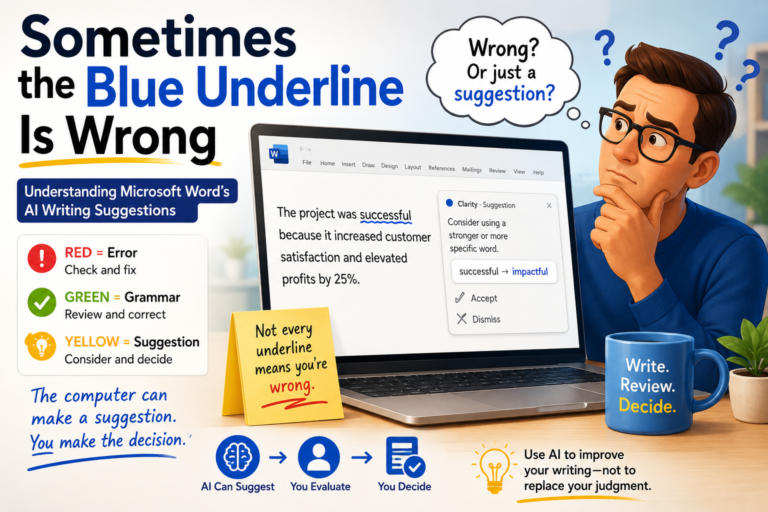
- Never assume that an underline automatically means: “You are wrong.”
Sometimes it means: “Here is another possibility. ”The Writer Still Has the Last Word. The old spellchecker could not tell Public from Pubic. The new assistants can tell a great deal more. That is why the writer still has to do the one thing neither cousin can do for you: decide whether the sentence still sounds like a person.
Note to myself: Remember this page. The decades in four countries—Hungary, Germany, the United States, and Canada—were not separate lives that happened to follow one another. They were one long apprenticeship in language, authority, classroom work, and the difference between help and diversion. Hungary taught you to notice when official wording starts replacing lived wording. Germany was part of the crossing.
The United States and Canada gave you the laboratory: thirty years of teaching Microsoft Word, thousands of adults, the specialist’s knowledge of the actual menus, and the North American professional voice that calls itself merely clear. The Franciscan classroom, the European university that passed from a communist institution to a Catholic one, the Office specialist credential, and the immigrant’s ear were never four decorations for a biography. They were the reason the unnamed house style was visible while it still looked, to many other people, like assistance. This article is one of the first times that labor belongs on the public table. Keep the porch sentence.
Keep the rejected-suggestion list.
Keep the distinction between a grammar error and a recommendation that wants to move the furniture. You were not collecting credentials.
You were becoming able to name the thing.
If you read this far in the post, it is worth going back and reading something that is also relevant; however, not as strong as this post. Let me know what you think. You can read it here.
I would like to thank Grok for helping my research information for this post. Thank you Grok! Awesome work!