
Hungary Stories · Eger
From Roundhouse Kicks to Excel IF Functions: Why Mastery Is Built One Repetition at a Time
A story about mastery through repetition that starts on a dojo floor in Eger and ends, unexpectedly, in a Microsoft Excel classroom decades later.
When people hear that I spent years practicing Kyokushin karate, they usually imagine dramatic fights, broken boards, or scenes from an action movie. The truth is much less glamorous.
Most of martial arts is repetition.
The same block.
The same punch.
The same kick.
Again.
Again.
And again.
Thousands of times.
At first, I never understood why my instructor insisted on repeating a technique hundreds of times. It felt excessive. Surely fifty kicks should be enough?
Apparently not.
I remember one training session where we practiced at least 300 mawashi geri (roundhouse kicks). By the end of the class, my legs were burning, my hips were exhausted, and I wondered whether my instructor had secretly declared war on our muscles.
Years later, I realized he wasn’t teaching us how to kick.
He was teaching our nervous systems.
A Style Born in Japan, Perfected Through Repetition in Eger
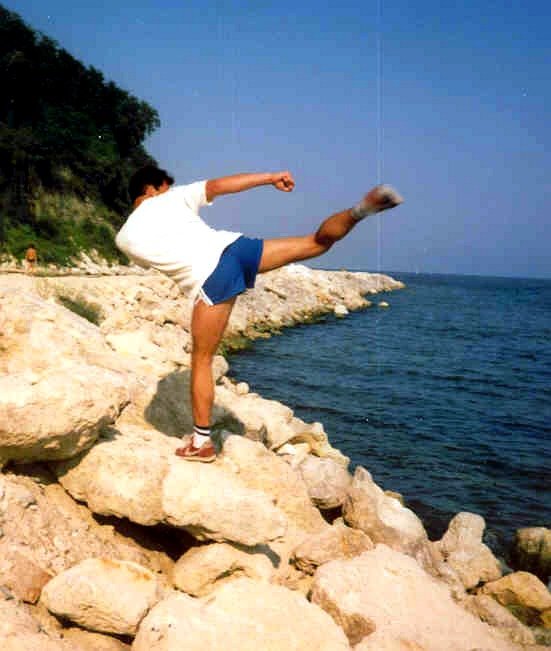
Kyokushin didn’t start in Eger, Hungary. It started in Japan, founded by a man named Mas Oyama, who built the style around one blunt idea: karate only means something if you test it for real. No pulled punches in training, no pretending. Oyama trained under freezing waterfalls, fought bulls, and once fought a hundred men in a row just to prove a technique could hold up under real pressure. That’s the tradition I walked into at twenty years old, when I joined Zoltan Lakatos’s dojo in Eger.
And it wasn’t a tradition I kept inside four walls. I practiced everywhere. In the snow, because winter doesn’t care about your training schedule. Standing in rivers, because balance means nothing if it only works on flat ground. And yes, on the rocks by the Black Sea, because apparently a beach vacation was still a training opportunity if you looked at it the right way.
- Founded: Japan, formally established 1964 by Mas Oyama
- Philosophy: full-contact, no pulled punches — technique has to hold up under real pressure
- Also trained in it: Dolph Lundgren (4th dan, European champion 1980–81) and Georges St-Pierre (3rd dan, started at age seven)
In Good Company
It’s also, strangely enough, a small thing Hollywood and the UFC agree on. Dolph Lundgren, before he ever played Ivan Drago, earned a 4th dan black belt in Kyokushin and was European champion in 1980 and 1981. Georges St-Pierre, one of the greatest fighters the UFC has ever seen, started Kyokushin at age seven to deal with a school bully and had a 2nd dan black belt by the time he was twelve. Different countries, different decades, same discipline underneath the surface. When I hear people talk about “natural talent,” I always think of that list. None of them got there by talent alone. They got there by repeating the same thing until it stopped being a technique and became part of them. That’s mastery through repetition, in its purest form.
The Night My Training Took Over
One evening after karate practice, I returned to my university dormitory.
Part of the hallway was dark where the lights didn’t quite reach.
Apparently one of my friends thought it would be funny to hide there and jump out to scare me.
He succeeded.
Sort of.
Before I consciously realized who had jumped in front of me, my body had already reacted.
My right leg snapped into a roundhouse kick.
Fortunately, I pulled the kick at the last instant and only tapped him lightly on the head.
Neither of us got hurt.
He looked surprised.
I looked even more surprised.
Years later, that same friend, Gocza Attila, became the police captain in Eger, Hungary.
One thing is certain.
He never tried to scare me again.
My Students Learned the Same Lesson
As I got older, I developed a habit of warning my students.
“Please don’t try to scare me.”
Naturally, they laughed.
Most people assume you’re joking when you say something like that.
One day a young paramedic student decided to test my theory.
She hid behind my car and jumped out as I approached.
My bag dropped to the ground.
My hand launched forward automatically.
Then it stopped.
About two inches from her face.
She froze.
I looked at her for a moment and said,
“You’re lucky you’re so pretty.”
She never tried that again either.
Neither story is about how tough I was.
Quite the opposite.
They’re about what happens when thousands of repetitions become part of your subconscious.
The goal of training wasn’t to react faster.
It was to react with control.
That’s what mastery through repetition looks like from the outside — quiet, until the moment it isn’t.
What Karate and Microsoft Excel Share: The Power of Repetition
Believe it or not, years later I found myself teaching something that looked completely different.
Microsoft Excel.
Specifically, the IF function.
Students often became frustrated.
They wanted to understand IF after seeing it once.
Some wanted to master nested IF statements after watching one demonstration.
I smiled because I had seen this movie before.
The dojo had simply become a computer classroom. Different subject, same mastery through repetition.
Whether you’re learning a roundhouse kick or an Excel IF function, your brain learns exactly the same way.
First you imitate.
Then you make mistakes.
Then you get frustrated.
Then something finally clicks.
Then you repeat it again.
And again.
Eventually your hands know what your brain struggled to understand.
After teaching thousands of adults over the years — you can see more of that training over on the Learn page — I discovered that confidence doesn’t come from understanding something once.
Confidence comes from doing it correctly enough times that you no longer have to think about it.
The Hungarian Word That Made Me Think
As a Hungarian, I’ve often noticed that some words lose something when translated into English.
Take the Hungarian word szeretet.
We usually translate it as “love.”
But somehow that feels incomplete.
Maybe it’s because, at least to my ear, I always hear the word etet inside it — the Hungarian verb meaning “to feed.”
Whether or not they’re historically related, I can’t help hearing that connection.
Real love feeds people.
It nourishes them.
It gives them strength.
The Word I Didn’t Have Until Years Later
Here’s something I never told my students, and never told you until now.
I didn’t start karate because I wanted to fight.
I started because somewhere, underneath everything, I wanted to become the kind of person who could fight and chose not to. A kid can’t put that into words. I just knew I wanted it.
It took me decades to find the actual word for it.
The Phrase That Named It
Recently I listened to Jordan Peterson discuss one of the most misunderstood verses in the Bible:
“Blessed are the meek, for they shall inherit the earth.”
Peterson argues that modern readers misunderstand the word meek. He often illustrates the idea by saying something like:
“Those who have swords and know how to use them, but keep them sheathed, shall inherit the world.”
That isn’t a literal translation of the Greek text, but it points toward something many biblical scholars and pastors also emphasize.
The original Greek word is πραΥς (praus).
Long before Christianity, Greek philosophers such as Aristotle used praus to describe a person whose strength was governed by wisdom.
Someone who was:
- capable of anger, but not ruled by anger
- capable of fighting, but not eager to fight
- powerful, yet self-controlled
- confident without arrogance
Many pastors summarize this idea with a simple phrase:
Strength under control.
The moment I heard that phrase, something clicked that I hadn’t expected.
That wasn’t a new idea to me.
It was the oldest idea I knew.
It was the hallway with my friend.
It was two inches from a paramedic’s face.
It was 300 roundhouse kicks that had nothing to do with kicking and everything to do with what happens the moment before you decide not to.
I’d spent years training my body for a philosophy I didn’t have a name for yet. Kyokushin never taught me to fight. It taught me praus, long before I knew the word existed, in a language I didn’t speak, from a tradition on the other side of the world from Eger.
Not aggression.
Control.
The same thing happens with the Hungarian word szeretet. English translates it as “love.” Technically that’s correct. Emotionally, culturally, and philosophically, it barely scratches the surface. Sometimes a translation is accurate. But it still doesn’t tell the whole story. Praus is the same. “Meek” is accurate. It’s also almost nothing like what the word actually means.
The Real Lesson: Mastery Through Repetition
Looking back, gymnastics taught me discipline.
Kyokushin karate taught me self-control.
Teaching Excel taught me patience.
At first those seem like completely unrelated chapters of my life.
Today I think they were all teaching exactly the same lesson.
Mastery through repetition isn’t built during moments of inspiration.
It’s built during ordinary Tuesdays when nobody is watching.
One correct repetition.
Then another.
Then another.
Character develops the same way.
Patience is practiced.
Kindness is practiced.
Courage is practiced.
Self-control is practiced.
Eventually they become part of who we are.
Perhaps that’s what the ancient Greeks understood when they spoke about praus.
Not weakness.
Not passivity.
Not fear.
Strength…
disciplined by wisdom.
And maybe that’s why the people who truly inherit the earth are not those who seek power over others, but those who first learn to master themselves.






A like fades in a second. A comment lives on and helps this moment spread across the globe.
Tell us what it meant to you ↓