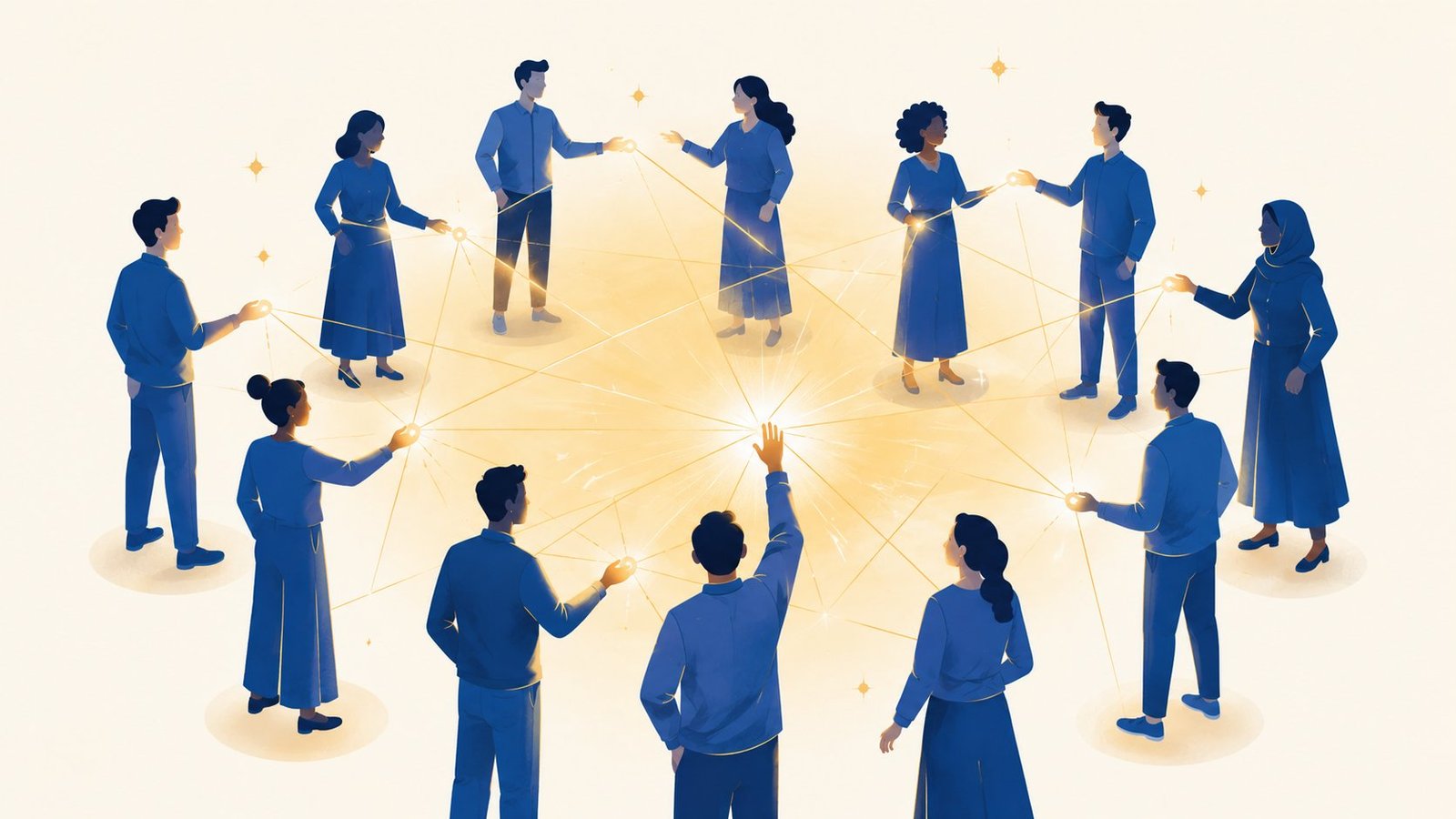
Building a Real Network for Real People
Building real connections between teachers, students, professionals, and communities.
There’s a trend going around HR circles right now called “conscious unbossing.” The short version: skilled people are deliberately turning down management roles. Not because they’re lazy or lack ambition, but because they’ve watched leadership roles consume people’s time and energy, and they’d rather protect their focus and their well-being than climb a ladder that often leads to burnout. I’ve seen versions of this pattern for thirty years. The people who do excellent work, who solve problems before anyone notices them, can become almost invisible. Quiet competence becomes its own trap. Nobody promotes the person who made everything look easy. Nobody writes about the fire that never started. I call this the Competence Paradox, and it has been the throughline of my teaching, my books, and my career. Something happened in my classroom the last few weeks that made me rethink one piece of that pattern. Opting out of visibility isn’t the only option. You can also build your own stage. What I Actually Told My Class. I teach Business Communications and PowerPoint. On paper, that’s slide design and email etiquette. In practice, I told my students something different this term. I told them I’m building a network of professionals who can communicate together, create meaningful communication that produces real results, and benefit their community while they’re at it. Then I asked them to prove it. Not with case studies out of a textbook. With their own lives.
- One student built a presentation on how to stop self-sabotage.
- Another designed a communication plan for a law firm that wants to make sure every client’s voice gets heard, starting with a free consultation.
- Someone else tackled forest fire prevention and management in Canada, real policy, real stakes.
- Another used art as therapy and showed the class how to talk about mental health without flinching from it.
None of it came from a chapter in a book. It came from what they already knew, encouraged into a shape other people could use. I showed them, step by step, how to turn that knowledge into a social post, a video, a piece of real communication instead of a grade in a gradebook. None of This Came from a Handbook. I want to be honest about where this comes from, because it didn’t come from a policy binder or a national teaching guideline. It came from people and experiences that shaped me long before I ever stood in front of a classroom. Some of it came from my Franciscan high school teachers, who gave their lives to giving students the best education they could, along with the standards, the morals, the discipline, and the perseverance to go with it. Some of it came from university, where the studying, the lessons, the practical exercises, and the testing demanded an intensity, discipline, and perseverance that stayed with me long after I graduated. Some of it came from a decision I made on my own, to learn computer technology in New Jersey, then go to New York right after to learn graphic design, because nobody handed me a roadmap and I wasn’t going to wait for one. Some of it came from every challenge that ever handed me an obstacle, a hardship, or a task nobody else could do efficiently. I learned to turn those into opportunities instead of complaints. My martial arts training taught me the same lesson in a different language: how to take suffering, hardship, and challenge, and turn it into something worth handing to the next person. That’s the real source. The curriculum is part of it, but it isn’t the whole of it. The curriculum is a baseline. Real teaching should go beyond it and encourage people to learn skills and improve themselves in a way that can change their lives for the better. A lifetime of people and pressure taught me how to turn hard things into something useful, and then how to teach other people to do the same. Then, They Turned It Back on Me. Here’s the part I didn’t see coming. In class, multiple students recommended that this work deserves national, or even international, attention. Nobody asked me first. One student, Sarah, then wrote a public thank-you letter and posted it on LinkedIn and Substack, and the class treated it as a collective statement, not just her own. Sarah’s words stopped me because she wasn’t simply thanking me for teaching software or business communication. She described something much larger: learning how to understand herself at a deeper level, recognize and break patterns of self-sabotage, build real confidence, communicate with intention, and believe in her own potential. She wrote about growth that reaches beyond the classroom into how people show up in their lives. That is the kind of feedback every teacher hopes to receive; however, rarely expects to see written publicly. Then, other former students joined the conversation. That changed the meaning of the moment for me. Thirty years, more than seven thousand students, and it took a handful of them deciding to speak up publicly, unprompted, for anyone outside the classroom to notice. That’s the Competence Paradox playing out in real time, except this time the ending is different, because the invisible work didn’t stay invisible. Someone chose to surface it. Perhaps that is the real measure of a teacher’s work. Not how many people remember your lessons, but how many people carry something from those lessons into the rest of their lives. That’s the piece “conscious unbossing” misses, I think. Opting out of visibility protects you from burnout, sure. But it also means the good work stays buried. What happened in my classroom is the other option: you don’t have to chase the spotlight, and you don’t have to hide from it either. You build something real enough that other people put the spotlight on you, because they wanted to.
Is This Rare?
Students have repeatedly told me they have not encountered this combination of personal experience turned into public communication and network-building inside a general college course elsewhere in Canada. When I looked for documented parallels, I found mostly social media marketing certificates built around campaigns for outside clients, and one academic paper on a service-learning communication project for nonprofits. Useful work, but a different thing entirely. That consistent student feedback is part of what makes me want to explore the idea further. Why This Matters Beyond My Classroom?
If you’re the person who quietly fixes things nobody sees, this is for you too. You don’t have to choose between burning out in a visible role or disappearing into an invisible one. There’s a third option:
- Build something real.
- Teach it and share it.
- Invite other people into it.
Let the work speak and let the people it helped decide whether to say something about it. My students did. I didn’t ask them to. That’s the whole point. Now, I want to take the idea one step further. I want to hear from people across Canada about the teachers, instructors, mentors, coaches, and educators who changed their lives; not because they simply followed a curriculum, but because they saw something in a person that the person hadn’t yet seen in themselves. What is one thing a teacher taught you that stayed with you long after the class ended? If someone like that changed your life, tell their story. Tag them if you can. Tell us what they taught you and what happened because of it. Maybe we can build something together: a real network of real people, connected not by the number of followers we have, but by the people who helped us become who we are.30 Years. 30 Stories. That may be where I start. I’d like to collect thirty stories from thirty years of teaching, stories from students who carried something from a classroom into a career, a family, a new opportunity, or simply a different way of seeing themselves. Perhaps it won’t stop at thirty. What I do live, whether I’m walking through Excel functions, advanced Word techniques, or a database project, isn’t just a demonstration. I’m troubleshooting in real time, pulling from tens of thousands of computer problems I’ve solved over thirty years, and weaving in real stories from real students, on the spot. You can watch it. You can even try to copy the format. But you can’t duplicate the years behind it, and you can’t duplicate the intention behind it, which has only ever been to lift people up. That part isn’t a technique. It’s not something you extract from a recording. It’s a relationship. Maybe that’s what education needs more of: not simply more connections, but more real connections between teachers, students, professionals, and communities.
Enjoying this article?





Thank you so much for this thoughtful and very well-written post, Attila. I truly appreciate the shout-out and, especially, the inclusion of my testimonial. It means a lot to me to be part of a conversation that highlights the importance of building real connections between teachers, students, professionals, and communities. Your point about building a “real network for real people” really resonates with me. The relationships we build along the way can be just as valuable as the knowledge and skills we gain, and sometimes those genuine connections are what help us grow the most. I also found your discussion of conscious unbossing particularly interesting. There is so much pressure to continually climb the ladder that we don’t always stop to ask whether the next rung actually aligns with the life we want to live. Choosing purpose, focus, and well-being isn’t a lack of ambition; it can be a very intentional form of it. I always say, self-care is not vanity; it is sanity. Thank you for continuing to create conversations that encourage us to think beyond the traditional definitions of success. I’m grateful to be part of the network you’re building.