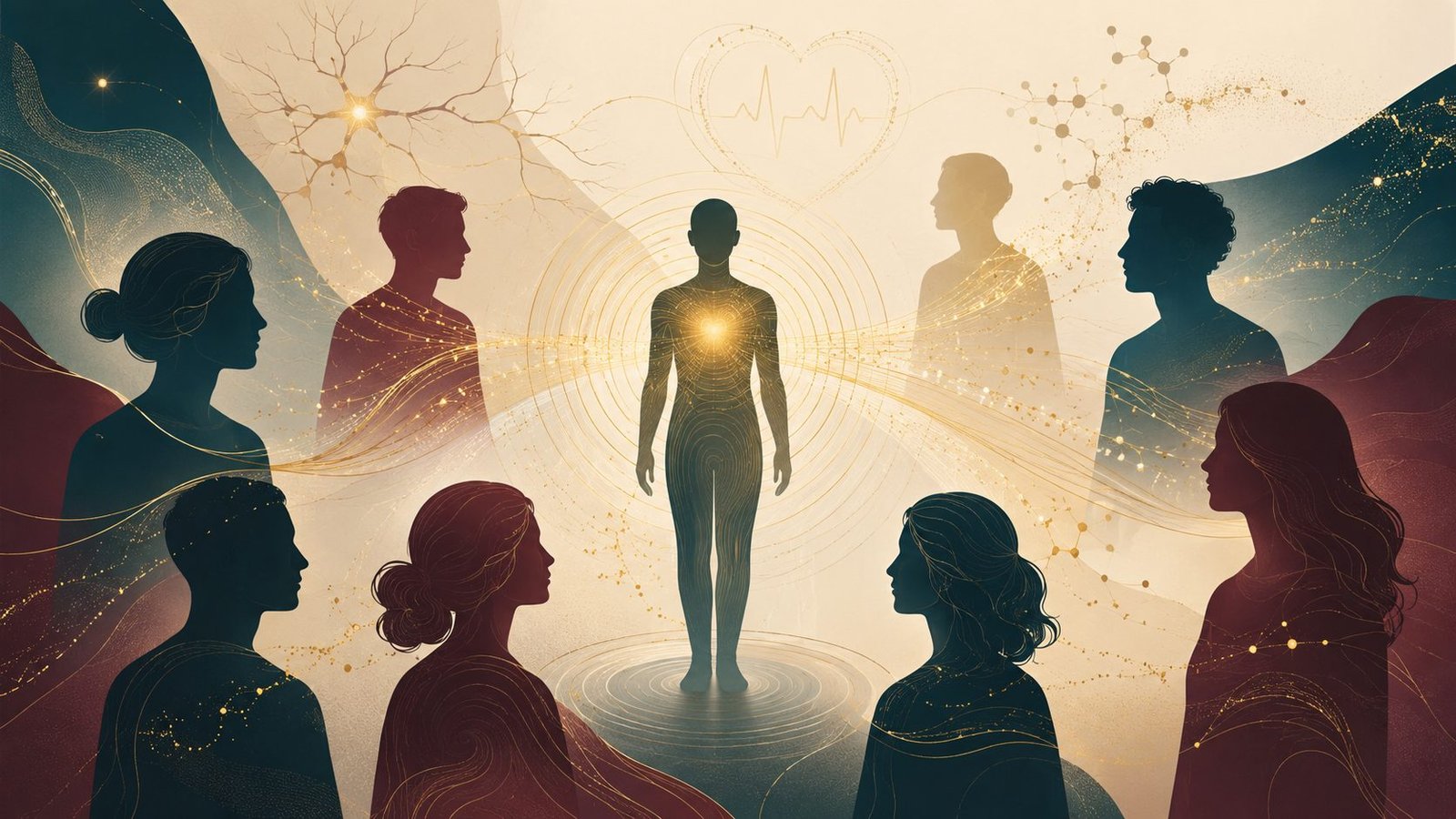
Emotional Contagion
The Hidden Science Behind Workplace Influence
The invisible threads aren’t mystical—they’re measurable, quantifiable, and scientifically validated.
Have you ever walked into a room and felt the tension before anyone said a word? Or noticed a leader’s calm settle an entire team without a single instruction being given? That’s not intuition. That’s emotional contagion — and modern science can now measure exactly how it happens.
What Modern Science Has Discovered
Emotional states don’t stay contained in the person feeling them. They transmit — chemically, electromagnetically, and behaviorally — whether we’re aware of it or not.
- Cortisol in Sweat — Scientists have detected 0.02–0.4 μM concentrations of the stress hormone in human sweat. Our emotional state leaves chemical traces on everything we touch. (Steckl & Ray, 2018)
- Amygdala Activation — Sweat from stressed skydivers triggers immediate fear-center activation in observers, detectable via fMRI, with a 100% detection rate. The brain recognizes emotional stress through chemical signals without conscious awareness. (de Groot et al., 2012)
- Airborne Transmission — Humans release “alarm substances” — airborne chemical signals that communicate emotional stress between people through chemosensory detection, entirely unconsciously. (Zhou & Chen, 2009)
- Electromagnetic Fields — The human heart generates electromagnetic fields detectable up to 8–12 feet away. Heart rate patterns can synchronize between nearby people through these measurable field interactions. (McCraty et al., 2017)
- Pheromone Effects — Androstadienone in male sweat measurably increases cortisol levels in women exposed to it. Chemical compounds in human secretions directly alter hormonal states in others. (Wyart et al., 2007)
- Mirror Neurons — Mirror neurons fire within 300 milliseconds of observing emotion in others — faster than conscious thought — creating corresponding emotional states in the observer automatically. (Iacoboni, 2009)
A Note About the Science
Some of the ideas presented in this article are supported by peer-reviewed research, while others are hypotheses or observations that I believe deserve further scientific investigation. This article is therefore intended partly as a thought experiment, informed by more than 30 years of hands-on experience teaching and working with over 7,000 adult students. I have deliberately included ideas that I find compelling but for which I am still seeking stronger scientific evidence. Where the science is established, I aim to distinguish it from speculation, and I welcome further research that may confirm, refine, or challenge these ideas.
What this means: emotional states physically manifest as measurable chemical signals, electromagnetic patterns, and behavioral cues — and they transmit automatically through multiple channels at once. This isn’t pseudoscience. It’s measurable biology, validating what traditional cultures taught for millennia. The invisible threads are real, detectable, and constantly operating.
What This Means for You
Understanding emotional contagion has immediate, practical applications — starting with two places most people never think to apply it.
Your Resume Carries Your Emotional State
When you write your resume while stressed, anxious, or defeated, cortisol from your sweat literally soaks into the paper. If you’re typing, your emotional state still shapes your word choice, sentence structure, and tone — in ways recruiters unconsciously pick up on through measurable linguistic markers.
Solution: before creating any important professional document, take time to regulate your emotional state first. Exercise. Meditate. Breathe deeply. Walk outside. The document you create will carry those positive markers instead — transmitted through both the physical paper and the digital word choices you make.
Your Workplace Emotions Spread
Your emotional state as a leader, teacher, or team member doesn’t stay confined to you. It spreads through chemical signals, electromagnetic fields, and behavioral cues — and your team absorbs your stress, anxiety, confidence, or calm whether you intend it or not.
Solution: name it. When you’re carrying heavy emotions into a professional setting, say so explicitly: “I’m dealing with some personal stress today, but I’m committed to being fully present with you.” This simple act of naming prevents unconscious transmission while keeping the connection authentic.
You Can Master This Force
Twenty cultures across five thousand years developed sophisticated practices to manage emotional energy transmission. These weren’t mystical rituals — they were practical techniques for regulating the same physiological states we now measure through cortisol levels, heart rate variability, and electromagnetic fields. Eight stand out for how directly they map onto what science is now confirming:
Qigong
Slow, coordinated breath and movement used for centuries to circulate “qi,” or vital energy. Modern studies link controlled, rhythmic breathing like this to measurable drops in cortisol and improved heart rate variability.
Pranayama
A core pillar of yogic practice built entirely around controlled breathing patterns. Different breath ratios are used deliberately to calm or energize the nervous system — a direct predecessor to what we now call vagal regulation.
Reiki
A practice built on the idea that focused attention and touch can shift another person’s state. Whatever its mechanism, it reflects an old, intuitive understanding that one person’s calm presence can measurably settle another’s.
Ubuntu Healing Practices
Rooted in the philosophy “I am because we are.” Community healing circles are used specifically to process shared grief or conflict out loud, preventing unspoken tension from spreading silently through a group.
Talking Circles
A Native American and First Nations tradition — only the person holding the talking piece may speak; everyone else listens without interrupting. This structure regulates the emotional tone of the whole group before decisions are made.
Hoʻoponopono
A structured Native Hawaiian family reconciliation ritual used to surface and release resentment before it festers. The practice assumes, correctly by modern measures, that unresolved tension in one person radiates outward to everyone around them.
Dhikr and Breath-Based Practice
A Sufi tradition of rhythmic breathing, chanting, and movement — including the whirling associated with Sufi practice — used to deliberately shift the nervous system from agitation into a calmer, more centered state.
Táltos and Regölés
Hungary’s pre-Christian shamanic healers, the táltos, used drumming and trance states to heal and restore balance within their communities. The tradition survives today in regölés, a winter folk-song custom whose chorus still echoes that trance-inducing root.
What to do with that:
- Practice intentional breathwork to regulate your nervous system
- Develop conscious awareness of your emotional state and its impact on others
- Use physical movement to shift stagnant emotional energy
- Build intentional routines that steady your state before high-stakes moments — meetings, presentations, difficult conversations, teaching sessions
A Final Note: This article deliberately explores the boundary between established science, personal observation, and hypothesis. Some claims require further peer-reviewed research. My goal is not to present every idea as settled science, but to ask whether observations accumulated over 30 years and thousands of human interactions point toward questions that science should investigate more deeply.
The Bottom Line
The invisible threads are always there. Science has caught up enough to prove it — the question now is whether you’ll ignore them, or learn to work with them intentionally, in the moments that matter most: on the page, in the room, and in front of your team.

A like fades in a second. A comment lives on and helps this moment spread across the globe.
Tell us what it meant to you ↓